ISO 2768 Tolerances: Selecting the Right Grade for Precision CNC Machining
Optimal ISO 2768 tolerance for CNC machining balances precision and cost. Select grade (f, m, c, v) per design, material, process for ideal 2768 specification.
Are your precision CNC machining projects burdened by inflated costs due to over-specified tolerances, or do you face performance issues from under-specified ones? This common dilemma is at the heart of effective engineering design.
The secret to achieving functional, cost-effective parts often lies within a nuanced understanding of ISO 2768 general tolerances. Mastering this standard transforms part manufacturing from a gamble into a predictable, optimized process.
This comprehensive guide, informed by ylc-machining’s extensive experience, will empower you to select the precise ISO 2768 tolerance grade. We’ll explore how to balance design intent, manufacturability, and cost, ensuring your CNC machined components meet exact specifications every time.
Understanding ISO 2768 Tolerances for CNC Machining
What is ISO 2768 tolerance for CNC machining?
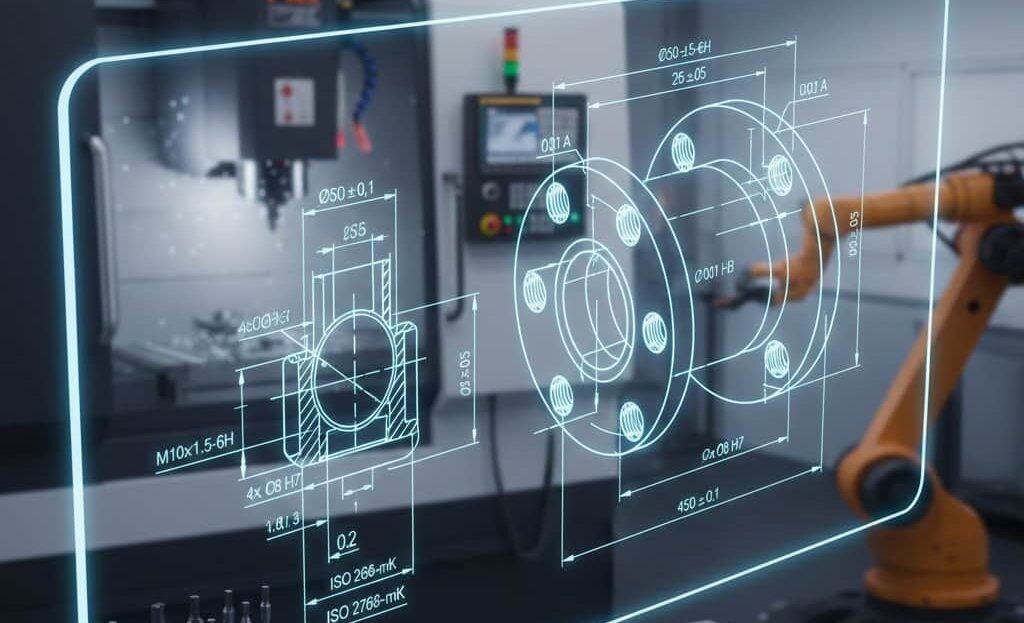
ISO 2768 specifies general tolerances for linear, angular, and geometric dimensions that are not individually specified on technical drawings. It’s crucial for CNC machining, providing a baseline for acceptable variations when tight, explicit tolerances aren’t called out. This standard ensures consistent quality and avoids unnecessary manufacturing costs.
These general 2768 tolerances are applied to features that are critical for part functionality but do not require individual, stringent GD&T callouts. By referencing ISO 2768, designers can streamline drawings, trusting that ylc-machining will uphold precise manufacturing standards. It acts as a safety net, defining the achievable precision for routine CNC manufacturing operations.
ISO 2768-1 vs. ISO 2768-2 Geometric Specification
ISO 2768 is divided into two parts, each addressing different aspects of a part’s dimensional accuracy. Understanding their distinction is fundamental for selecting the correct 2768 specification for your designs. Both are indispensable for achieving specified precision in CNC machining.
ISO 2768-1 covers linear and angular dimensions, providing four tolerance classes: ‘f’ (fine), ‘m’ (medium), ‘c’ (coarse), and ‘v’ (very coarse). This part is frequently used for general dimensions that do not have specific tolerance values noted on the drawing. ylc-machining rigorously adheres to these guidelines, ensuring consistent dimensional outcomes.
ISO 2768-2 addresses geometric tolerances, specifically for form, orientation, location, and run-out. It works in conjunction with ISO 2768-1 when geometric requirements are not explicitly stated. The geometric specifications covered often include straightness, flatness, perpendicularity, symmetry, and circular run-out.

Common misconceptions about ISO 2768 precision in design.
One prevalent misconception is that applying ISO 2768 automatically guarantees high precision across all features. While it sets a reliable baseline, it’s a “general tolerance” standard. Critical features requiring extreme precision often need explicit GD&T callouts.
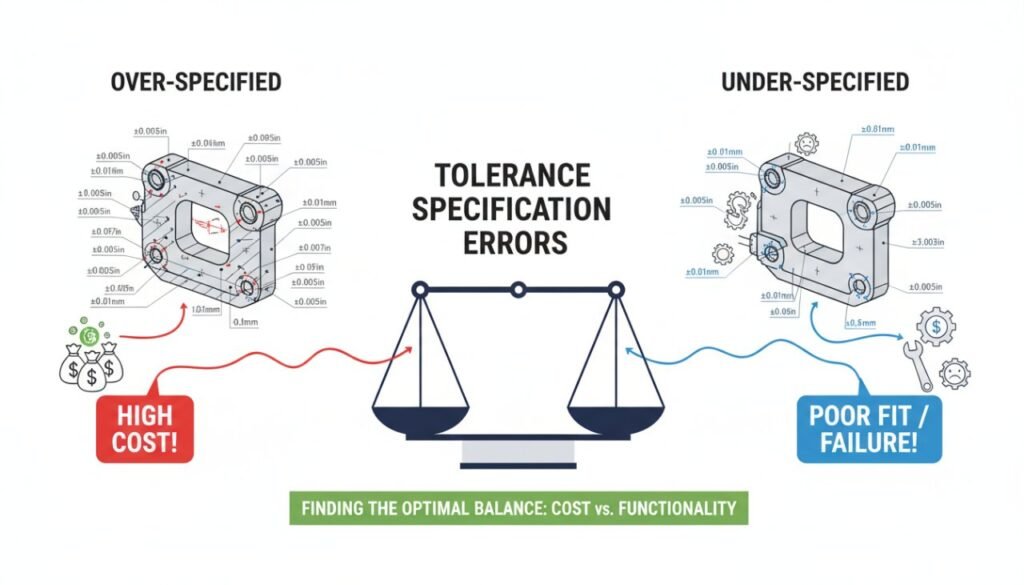
Another common error is to indiscriminately apply the tightest class, ‘f’, across an entire drawing. This can lead to significant cost increases and longer lead times without actual functional benefit. ylc-machining frequently guides clients in optimizing their 2768 specification choices.
Conversely, some designers assume loose tolerances, leading to parts that fail during assembly or operation. Relying solely on general 2768 tolerance without considering part function can compromise quality. A balanced approach, informed by an expert CNC machining partner, is always best.
Navigating ISO 2768 Tolerance Classes (f, m, c, v)
Decoding ISO 2768-1: Fine, Medium, Coarse tolerance
ISO 2768-1 provides a graded system for linear and angular dimensions, allowing designers to specify a level of manufacturing precision appropriate for the part’s function. The selection of ‘f’, ‘m’, ‘c’, or ‘v’ directly impacts manufacturability and cost. Each class defines a range of acceptable deviation from the nominal dimension.
The fine (f) class is for high-precision components, often with mating parts or tight assembly requirements. Medium (m) is the most common and serves as a default for general engineering applications where reasonable precision is needed.
Coarse (c) is for less critical dimensions, where larger deviations are acceptable, often for components with ample clearances. Very coarse (v) is for dimensions where functionality is minimally affected by loose tolerances, such as raw material cut lengths or non-critical features. ylc-machining advises clients on the practical implications of each grade.

Below is a simplified table showing examples of ISO 2768-1 linear tolerances for different nominal sizes.
Table: ISO 2768-1 Linear Tolerances (Nominal Size Range in mm)
| Nominal Size Range (mm) | Fine (f) | Medium (m) | Coarse (c) | Very Coarse (v) |
|---|---|---|---|---|
| 0.5 – 3 | +/- 0.05 | +/- 0.1 | +/- 0.2 | +/- 0.5 |
| >3 – 6 | +/- 0.05 | +/- 0.1 | +/- 0.3 | +/- 0.5 |
| >6 – 30 | +/- 0.1 | +/- 0.2 | +/- 0.5 | +/- 1 |
| >30 – 120 | +/- 0.15 | +/- 0.3 | +/- 0.8 | +/- 1.5 |
| >120 – 400 | +/- 0.2 | +/- 0.5 | +/- 1.2 | +/- 2 |
Practical Application of ISO 2768-2 Specification
ISO 2768-2 specifies general geometric tolerances for features without individual geometric tolerance indications. These tolerances relate to the form (e.g., straightness, flatness), orientation (e.g., perpendicularity), location (e.g., symmetry), and run-out of features. Applying these specifications requires understanding their impact on part functionality.
For instance, a flatness requirement might be critical for a mating surface, even if not explicitly dimensioned. ylc-machining’s expertise ensures these implicit 2768 precision needs are met. The general geometric tolerance class chosen is often derived from the linear tolerance class of the part.
Table: ISO 2768-2 Flatness Tolerance (Nominal Size Range in mm)
| Nominal Length (mm) | Tolerance (mm) |
|---|---|
| 0.5 – 10 | 0.02 |
| >10 – 30 | 0.05 |
| >30 – 100 | 0.1 |
| >100 – 300 | 0.2 |
| >300 – 1000 | 0.4 |
| >1000 – 3000 | 0.6 |
This standard streamlines drawings but places responsibility on the manufacturer to interpret and apply the correct 2768 specification. ylc-machining leverages advanced CNC manufacturing capabilities to achieve these implicit geometric accuracies. Our skilled machinists understand the nuances of these general geometric tolerances.
Impact of dimension size on 2768 Tolerance selection.
The nominal size of a dimension is a primary factor in determining the acceptable 2768 tolerance. As dimensions increase, the absolute tolerance value typically expands. This is a fundamental principle embedded within the ISO 2768 standard’s tables.
For example, a 10 mm feature will have a tighter absolute tolerance than a 100 mm feature, even if both are specified to the same ‘m’ (medium) class. This scaling effect reflects the practical challenges and costs associated with maintaining tight proportional accuracy over larger dimensions during CNC machining.
Designers must consult the relevant ISO 2768 tables for specific size ranges. Incorrectly applying a tolerance value from a different size range is a common mistake that ylc-machining often identifies and corrects during design reviews. Precise adherence to size-dependent tolerance bands is essential for robust part design.
Optimizing ISO 2768 Tolerance: Cost & Function
2768 Tolerance: Cost Impact on CNC Machining Budgets
The choice of ISO 2768 tolerance grade directly correlates with manufacturing costs. Tighter tolerances, like ‘f’ (fine), require more precise machinery, specialized tooling, slower machining speeds, and additional inspection steps. These factors significantly increase the unit cost of parts.
Over-specifying 2768 precision for non-critical features is a frequent source of unnecessary expenditure. ylc-machining emphasizes a value engineering approach, working with clients to ensure tolerances are no tighter than functionally necessary. This optimization is key to managing CNC machining budgets effectively.
Conversely, under-specifying tolerances can lead to functional failures, assembly issues, or the need for costly rework. Striking the right balance is crucial. ylc-machining’s transparent pricing models clearly reflect the cost implications of various 2768 specification levels, allowing informed design decisions.

Functional Needs vs. Manufacturability for 2768 Tolerance
Every part feature has a functional requirement that dictates its necessary precision. A bearing seat, for example, demands high 2768 precision, likely requiring ‘f’ or individual GD&T. A mounting hole for a loose bolt, however, might only need ‘m’ or even ‘c’.
Balancing these functional needs with manufacturability is paramount. Extremely tight tolerances can push the limits of even the most advanced CNC machining processes. Material properties also play a role; some materials are harder to machine to tight 2768 tolerance than others.
ylc-machining’s engineers possess deep expertise in material science and machining capabilities. They collaborate with designers to analyze functional requirements against manufacturing realities, ensuring that chosen 2768 tolerances are both achievable and cost-effective. This collaborative approach minimizes design-for-manufacturability issues.

General 2768 Tolerance vs. Specific GD&T Selection
While ISO 2768 provides essential general tolerances, it is not a substitute for Geometric Dimensioning and Tolerancing (GD&T) for critical features. GD&T allows for precise, unambiguous specification of form, orientation, location, and run-out, often linked to a datum scheme.
When a feature’s function is highly dependent on its relationship to other features, or when its form must be tightly controlled regardless of its size, specific GD&T callouts are indispensable. For instance, flatness on a sealing surface or concentricity of a shaft requires explicit GD&T.
General 2768 tolerance is ideal for features where precision is important but not paramount, or for features whose function is less sensitive to small variations. ylc-machining advises designers on when to rely on general 2768 precision and when to employ specific GD&T for optimal part performance and cost. Our team is proficient in both.
Expert Guide: Right ISO 2768 Specification
Step-by-Step Framework for 2768 Tolerance Selection
Selecting the correct ISO 2768 tolerance involves a systematic approach. First, understand the part’s overall functional requirements and identify critical versus non-critical features. This initial assessment guides the general precision level needed.
Next, consider the material being machined. Some materials inherently allow for tighter tolerances than others. Then, evaluate the manufacturing process; ylc-machining’s advanced CNC machining capabilities can achieve tighter tolerances than standard methods.
Finally, refer to the ISO 2768-1 and ISO 2768-2 tables, using the part’s nominal dimensions to determine the specific tolerance values for ‘f’, ‘m’, ‘c’, or ‘v’. Always prioritize functional needs, then optimize for manufacturability and cost. ylc-machining’s engineers can assist with this comprehensive analysis.
Case Studies: Optimizing 2768 Precision in CNC Machining
Case Study: Automotive Component Bracket
Problem: A client approached ylc-machining with an automotive bracket drawing that specified ISO 2768-m for all features. However, several non-critical mounting holes and edge chamfers were driving up costs without adding functional value, due to the blanket application of the ‘m’ class. The current manufacturing process was slow and expensive.
Our Solution: ylc-machining’s engineering team performed a detailed design review. We identified that while the main fastening features indeed required ‘m’ class 2768 tolerance, the non-critical holes could be specified to ‘c’ (coarse) and the chamfers to ‘v’ (very coarse) without impacting function. We proposed a revised 2768 specification for these features.
Result: By optimizing the ISO 2768 specification, ylc-machining helped the client achieve significant cost savings of 18% per unit. Production time was reduced by 10%, demonstrating how tailored 2768 tolerance selection, informed by our CNC machining expertise, can yield substantial benefits. The client received high-quality parts that met all functional criteria.
Communicating 2768 Tolerances Requirements to Manufacturers
Clear communication of ISO 2768 tolerance requirements is paramount for successful CNC machining. Always specify the applicable ISO 2768 standard (e.g., ISO 2768-1 mK, ISO 2768-2 H) in your drawing title block or general notes. This leaves no room for ambiguity.
If certain features deviate from the general tolerance, ensure they are explicitly called out with specific dimensional tolerances or GD&T symbols. Do not assume a manufacturer will interpret implicit needs. ylc-machining encourages open dialogue regarding any unique 2768 precision requirements.
Providing a tolerance analysis report or engaging in a design-for-manufacturability (DFM) review with ylc-machining can further clarify expectations. Our technical team works proactively with clients to ensure all 2768 specifications are clearly understood and achievable. This collaborative approach ensures optimal outcomes.
Our ISO 2768 Expertise in CNC Machining
Leveraging Expertise for Optimal 2768 Tolerance
ylc-machining stands as a leader in precision CNC manufacturing, distinguished by our profound expertise in ISO 2768 tolerances. Our engineers don’t just read the standards; they live and breathe them, applying deep practical knowledge to every project. This ensures your designs are not only functional but also cost-optimized for production.
We possess state-of-the-art CNC machining equipment capable of achieving very fine (f) 2768 precision, as well as complex GD&T requirements. Our hands-on experience allows us to advise on the most appropriate tolerance grade, preventing both over-tolerancing and under-tolerancing. ylc-machining translates your design intent into tangible, high-quality parts.
Our team offers comprehensive DFM services, reviewing your drawings to identify areas where ISO 2768 tolerance can be optimized. We suggest adjustments that maintain part functionality while reducing manufacturing complexity and cost. ylc-machining’s commitment to excellence ensures superior 2768 specification adherence.
Transparent Pricing for Various 2768 Specification Levels
At ylc-machining, transparency in pricing is a core value, especially concerning the cost implications of ISO 2768 tolerance grades. We provide detailed quotes that clearly differentiate the costs associated with achieving different levels of 2768 precision. This allows clients to make informed budgetary decisions.
Our cost breakdowns demonstrate how tighter ‘f’ (fine) class tolerances typically involve higher costs due to increased machining time, specialized tools, and stringent quality control. Conversely, ‘m’ (medium) or ‘c’ (coarse) 2768 specifications offer more economical production. ylc-machining provides a clear understanding of these trade-offs.
We believe that understanding the cost drivers empowers our clients. By partnering with ylc-machining, you gain access to a supplier that provides fair, predictable pricing, allowing for precise project budgeting without hidden fees related to 2768 specification. Our goal is to ensure value through both quality and cost-efficiency.
High-Quality Parts through Rigorous 2768 Precision Control
Achieving high-quality parts is the cornerstone of ylc-machining’s operation, and rigorous control over ISO 2768 precision is central to this. Our quality management system, certified to industry standards like AS9100, ensures that every component meets or exceeds the specified 2768 tolerance.
We employ advanced metrology equipment, including CMMs and optical inspection systems, to verify dimensional accuracy and geometric form. This meticulous inspection process ensures that even the most subtle deviations from the intended 2768 specification are detected and addressed. ylc-machining delivers consistent, reliable quality.

Our skilled machinists are continually trained in the latest CNC manufacturing techniques to maintain tight 2768 precision. From material selection to final inspection, every step of the production process is optimized for quality and adherence to specified 2768 tolerances. Trust ylc-machining for unparalleled precision and reliability.
Master ISO 2768 Tolerance Selection
Key Takeaways: Optimizing Design with ISO 2768 Tolerances
Mastering ISO 2768 tolerance is essential for any engineer or designer involved in precision CNC machining. The standard provides a powerful tool for streamlining drawings and ensuring consistent part quality. Understanding the distinctions between ISO 2768-1 and ISO 2768-2 is fundamental.
Remember that selecting the right grade (f, m, c, v) requires a careful balance between functional necessity, material properties, and manufacturing cost. Over-tolerancing inflates budgets, while under-tolerancing compromises performance. ylc-machining offers the expertise to navigate these complexities.
Always clearly communicate your 2768 specification requirements to your manufacturing partner. Collaborate with experts to optimize your tolerance strategy, leveraging both general tolerances and specific GD&T where appropriate. This holistic approach ensures successful product development.
Partner for Unparalleled 2768 Precision in CNC Machining
Choosing the right manufacturing partner is as critical as selecting the correct ISO 2768 specification. ylc-machining is a proven source manufacturer with a track record of delivering high-quality, high-precision CNC machined parts. Our commitment to E-E-A-T principles means you get reliable, expert service.
ylc-machining’s deep technical expertise and advanced manufacturing capabilities ensure that your designs, with their specific 2768 tolerance requirements, are realized to perfection. We are dedicated to providing transparent pricing and exceptional customer service, fostering long-term partnerships.
Whether your project demands ‘f’ (fine) 2768 precision or a combination of general and specific GD&T, ylc-machining has the experience and technology to exceed your expectations. Partner with us for reliable, high-quality CNC manufacturing.
Free 2768 Specification Consultation with Our Experts
Don’t leave your ISO 2768 tolerance selection to chance. Leverage ylc-machining’s deep technical expertise to ensure optimal part performance and cost-efficiency. Our engineering team is ready to assist you.
Contact ylc-machining today for a free tolerance analysis and a transparent quote on your next precision CNC machining project. Let us help you refine your 2768 specification for superior results.
FAQ Section
How does ISO 2768 reduce drawing complexity?
ISO 2768 allows designers to omit individual tolerance callouts for many dimensions. Instead, a single note in the title block references the standard and chosen class.
This significantly simplifies technical drawings, making them cleaner and easier to read. It streamlines the design process for general 2768 precision.
Can ISO 2768 replace all GD&T?
No, ISO 2768 provides general tolerances for basic dimensions and forms. It is not a substitute for specific Geometric Dimensioning and Tolerancing (GD&T).
Critical features requiring precise control over form, orientation, location, or run-out must still use explicit GD&T. ylc-machining helps determine when specific GD&T is essential.
What is the most common ISO 2768 class for CNC?
The medium (m) class of ISO 2768-1 is generally the most common choice for many general engineering applications. It offers a good balance between precision and cost.
However, the optimal 2768 specification depends entirely on the part’s function, material, and specific design intent. ylc-machining always recommends a tailored approach.